Marie - Helene H.
Très beau jouet

Populaire zoekopdrachten
Zoeken op budget
1 klik om te filterenPer leeftijd
Snelle selectie
Geen artikelen gevonden
We hebben geen artikelen gevonden voor deze zoekopdracht. Probeer een algemenere zoekterm of een ander budgetfilter.
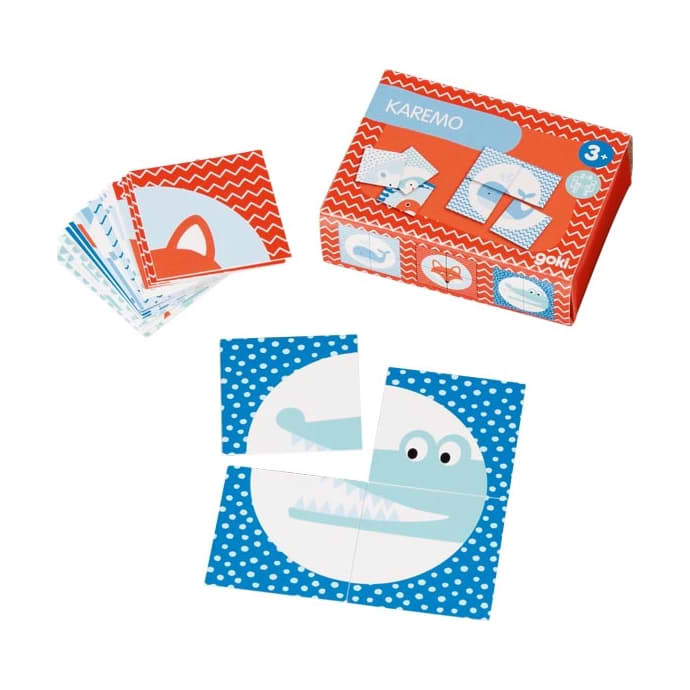
Alle 600+ artikelen ontdekken →Karemo is a card game for kids from 3 years in which four square cards come together to rebuild an animal portrait: a crocodile, a fox, a whale. A matching card game in a Goki pocket box, for 2 to 4 players.
Ref. : REFG56755-1
Inside the small red box with white chevrons is a pack of square cards, and each one shows a quarter of a stylised animal. Your child spreads them out on the table, spots a toothy jaw here and an orange ear there, then slides four pieces together until the portrait closes inside its circle: a pale blue crocodile on a blue background with white dots, an orange fox, a blue whale. Karemo is a card game for kids that plays like a run of tiny jigsaws, one animal after another, with nothing to read and no score to keep.
Because every animal is split into exactly four cards, the task stays small enough for young hands. The child holds a card, looks at it, looks at the others, picks one up, turns it, tries it against the first. When the last quarter drops into place, the face is suddenly whole, and that moment is what makes children reach for the next animal.
Rebuilding an animal is a matter of looking closely. The backgrounds do most of the work: dots, chevrons, waves and colour tell the child which cards belong together long before the animal itself is recognisable. That makes Karemo a matching card game of a particular kind: the child is not looking for two identical pictures but for four parts that continue each other.
Then comes the second step, and it is the one that surprises adults: each card has to be turned so that the circle lines up. Two right cards placed the wrong way round leave a broken outline. Rotating a small square between finger and thumb until the curve meets the curve is a real exercise in spatial orientation, done with the hand rather than explained in words. This is where Karemo earns its place as an educational card game: attention to detail and a sense of position grow through a gesture the child repeats dozens of times in one sitting.
The picture also checks the answer. If one quarter is wrong or badly oriented, the portrait simply does not close, and the child sees it without anyone pointing it out. The Montessori approach calls this control of error: the material itself tells the child whether the work is right, so they correct it themselves and keep going.
With a child of 3, start with a single animal, cards face up. Assemble it in front of them, take it apart, and hand the four cards over. Most children rebuild it at once and ask for another. Avoid tipping the whole pack onto the table at the start: too many quarters at once blur the patterns, and the game turns into a frustrating heap instead of a puzzle.
Once your child puts an animal together without hesitating, mix two or three animals and let them sort the cards by background before building. The next step is to play together: each player rebuilds the animal of their choice in turn, and everyone watches the portraits appear. That is what makes Karemo one of the easy card games for kids: no hidden hands, no bluffing, and no reading. It is also a card game for kids that works with 2 players as well as with 4, so it suits a parent and child just as well as a group of siblings.
Around 4, many children want a challenge, and Karemo turns into a small race: shuffle the cards, deal them out, and see who closes a portrait first. You can also hide one quarter and ask which animal is missing a piece. These variations keep the same simple rule, which is why it often sits among the simple card games for kids that families keep coming back to.
At 3, the pleasure is in the assembling itself, and an adult nearby helps by naming the animals and the colours. Between 4 and 5, children start to anticipate: they recognise a fox from a single ear, hunt for the right background on purpose and turn the card before they even place it. By then this card game for kids has become quick, and they enjoy timing themselves or teaching it to a younger cousin.
The box is the other reason parents pick it. It slips into a handbag or a coat pocket, which puts it among the children's travel games that actually come out of the bag: at a restaurant while waiting for food, on the train, at the grandparents'. Among small card games for travel, it has the advantage of needing only a little table space. If you are packing travel games for 3 year olds, it also fits easily next to a book and a snack, and it is the kind of tiny box that works as a stocking filler card game for Christmas.
Like all cardboard cards, these dislike water and sticky fingers. Play on a dry table, keep drinks at a distance, and put the cards back in their box after each game so that no quarter of an animal goes missing: a portrait with three pieces cannot be finished.
Goki makes this pocket format in three versions, all from 3 years and all in the same small box. They are not three skins of one game: each asks for something different. Karemo suits the child who likes assembling and observing, and it can be played without any competition at all. The Happy Families version asks the child to request a precise card from another player, and Black Bear, an Old Maid style game, is about forming pairs while avoiding the one card nobody wants. Those two come naturally afterwards, once your child is comfortable holding cards and taking turns.
If you are comparing the best card games for kids for a first collection of mini travel games, Karemo is the gentlest start of the three. Good card games for kids at this age share one quality: the rule fits in a sentence, and the child can see what to do. Fun card games for kids at 3 are mostly about doing something with the cards, and here the child is busy with every single card. For larger puzzles in wood, have a look at our puzzles and tangrams. Our board games prepare children for turn-taking and first rules, and the learning games gather other educational card games for kids alongside counting and colour games.
Show one animal already assembled, take it apart, then let your child rebuild it. Add a second animal only once the first one is easy, and keep the cards face up.
The box shows 2 to 4 players. You can also simply rebuild the animals one by one with your child, for the pleasure of seeing the portraits appear.
Yes: the pocket box takes up almost no room, there is no board, and each animal is a short task that fits a wait at a restaurant or a train journey. Just bring the box back with every card inside.
All three share the same pocket box and start from 3 years. Karemo is the only one played like a puzzle, with or without competition, whereas Happy Families and Black Bear are played with a hand of cards.
3+
Drukbestendig Dik Kwaliteitspapier
CE & EN 71 gecertificeerd, niet-giftige verf en was op waterbasis
Nieuw (Originele verpakking)
Afstoffen met een droge doek. Beschermen tegen vocht en langdurig direct zonlicht.
Rechtop of plat op een lage plank op kinderhoogte bewaren volgens de Montessori-principes.
Dit speelgoed heeft nog geen individuele beoordeling ontvangen. Ontdek de gecertificeerde beoordelingen van andere gezinnen.
Très beau jouet
Beau jouet mais la tête du clown rentre entièrement dans la bouche de mon petit fils (12mois) …. Ce qui ne me rassure pas !
Envoi rapide, produits conformes à la description.
Rapide, efficace et jeux top!
Astucieux ! Compris l'heure en un rien de temps, la mémoire a fait le reste. Ludique +++
Génial !
Ander sensorisch en educatief leermateriaal ontworpen voor deze ontwikkelingsfase.