Marie - Helene H.
Très beau jouet
Populaire zoekopdrachten
Zoeken op budget
1 klik om te filterenPer leeftijd
Snelle selectie
Geen artikelen gevonden
We hebben geen artikelen gevonden voor deze zoekopdracht. Probeer een algemenere zoekterm of een ander budgetfilter.
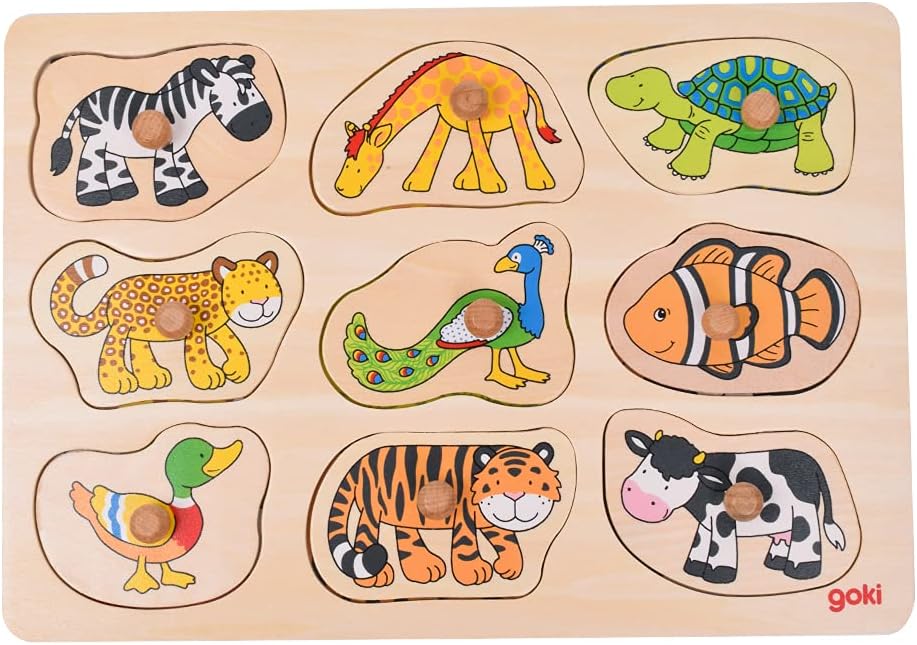
Alle 600+ artikelen ontdekken →This knob puzzle sets nine animals, from the zebra to the cow, into a wooden board, each lifted by its own chunky knob. Under every piece, a printed coat, shell or set of feathers gives a second clue. Like many wooden Montessori toys, it lets the board itself show the right place. From 1 year.
Ref. : REFG57585
The board holds nine animals: a zebra, a giraffe, a tortoise, a leopard, a peacock, a clownfish, a mallard duck, a tiger and a cow. A wooden knob stands up from the middle of each piece. Your child pinches it between thumb and forefinger, pulls upwards, and the animal comes out of its hollow. Where it sat, a picture appears: black and white stripes under the zebra, large orange patches under the giraffe, a black and white hide under the cow, green and red feathers under the duck.
Then comes the way back: picking the animal up by its knob again, finding the hollow that belongs to it, turning it until it drops flat. Some children empty the whole knob puzzle before filling it again; others lift the same animal out and put it back several times in a row, just to see the stripes appear and disappear.
Catching a small wooden knob means bringing thumb and forefinger together, the pincer grip that a one-year-old refines month after month. Few pincer grasp toys repeat the movement this often: nine knobs to lift and nine pieces to return in a single round. The gesture is small, but it is fine motor practice that your child chooses to repeat rather than an exercise you set.
Putting a piece back asks for more. The animal has to be turned, brought over the right hollow and nudged until it sinks in. The eyes spot the pattern, the hand carries the animal to it: hand–eye coordination, nine times per round.
Each piece has its own outline and fits only its own space, and the printed picture adds a second check. Set the tortoise on the zebra's stripes and it will not sink in, and the drawing plainly does not match its shell. The material shows the mistake by itself, which the Montessori approach calls control of error: nobody needs to step in and correct your child.
Start with the board full. Lift out a single animal, show the pattern it was hiding and name it ("the zebra's stripes"), then let your child put it back. The common mistake is tipping all nine pieces out in front of a one-year-old, who then faces too many choices in one go and often gives up. Offer the knob puzzle with just a few hollows empty, and add the other animals over the following days.
When every piece goes back without help, change the game. Lay the animals in a pile next to the board and ask, "Who has these spots?" The board then works as a picture matching game: your child reads the pattern first and only afterwards looks for the animal, the reverse of the first way of playing.
At first, your child lifts and replaces mainly for the pleasure of the movement while you name the animals. Later, they name them on their own, moo like the cow or quack like the duck, then pick up the words for coats and skins: stripes, spots, feathers, shell. The clownfish, the peacock and the tortoise also lend themselves to talking about colours. At that stage the board becomes one of the first matching games for toddlers, with no cards to lose and nothing to read.
This knob puzzle isolates one difficulty at a time: the grip first, then the match, then the word. That step-by-step progression is a principle shared by Montessori toys for toddlers, and here it comes from the material itself rather than from a set of rules. With its mix of farm, wild and sea creatures, the board also sits well beside other animal toys on a low shelf.
Wipe the wood with a barely damp cloth, never soak it, and let it dry in the open air. Put the animals back in the board after each session: a lost piece leaves a pattern with no owner, and the game loses its point.
On many peg puzzles, the hollow stays blank after the piece is lifted, so only the outline guides the child. Here the picture underneath gives a second clue and turns every piece into a small riddle. That brings this knob puzzle close to a matching game, while keeping the simple lift-and-place movement a one-year-old can manage.
Many wooden puzzles for babies keep to a single theme, such as farm animals or vehicles. This board mixes nine very different creatures, which gives more to name and compare. Parents who already know jumbo knob puzzles will recognise the chunky knob on every piece; the difference lies in the hidden patterns. For other first toys at the same stage, browse our toys for 0 to 24 months.
Goki recommends it from 1 year. The chunky wooden knobs are sized for small hands, and lifting them is exactly the movement that toys to develop pincer grasp rely on. Your child can begin with one empty hollow before moving on to all nine.
Two clues guide them: the outline of the piece, which fits only its own hollow, and the picture printed underneath, which shows the coat, feathers or shell of that animal.
Nine animals: zebra, giraffe, tortoise, leopard, peacock, clownfish, mallard duck, tiger and cow. Goki gives the dimensions as 29.9 x 20.8 x 2.4 cm.
1+
Duurzaam Natuurlijk Hout
CE & EN 71 gecertificeerd, niet-giftige verf en was op waterbasis
Nieuw (Originele verpakking)
Reinigen met een zachte, met lauw water licht bevochtigde doek. Hout nooit onderdompelen of agressieve reinigingsmiddelen gebruiken.
Breng eenmaal per jaar een druppel plantaardige olie of bijenwas aan om de natuurlijke glans jarenlang te behouden.
Dit speelgoed heeft nog geen individuele beoordeling ontvangen. Ontdek de gecertificeerde beoordelingen van andere gezinnen.
Très beau jouet
Beau jouet mais la tête du clown rentre entièrement dans la bouche de mon petit fils (12mois) …. Ce qui ne me rassure pas !
Envoi rapide, produits conformes à la description.
Rapide, efficace et jeux top!
Astucieux ! Compris l'heure en un rien de temps, la mémoire a fait le reste. Ludique +++
Génial !
Ander sensorisch en educatief leermateriaal ontworpen voor deze ontwikkelingsfase.